Deciphering the Repair Mechanisms that Restore the Injured Mammalian Pancreas
The Sosa-Pineda Lab
The pancreas performs essential functions that support whole-body homeostasis by producing digestive enzymes needed for nutrient absorption and hormones that regulate blood glucose levels. When the pancreas is damaged by injury or disease, the consequences can be severe and life-threatening.
At the Sosa-Pineda lab, we investigate how the pancreas develops, functions and repairs. Using genetic mouse models, pharmacologic approaches, and state-of-the-art imaging and molecular technologies, we uncover mechanisms that guide pancreatic development and drive tissue repair after injury. Our goal is to better understand pancreatic disease and identify new therapeutic strategies.
Browse Our Work
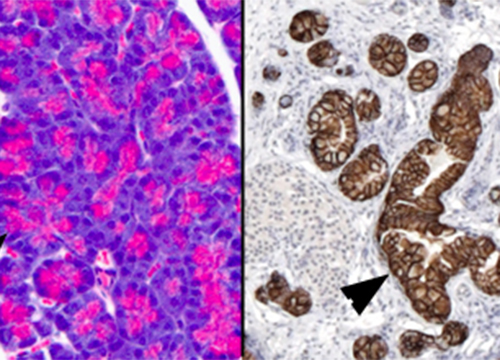
Acinar Differentation
Pancreatic acinar cells (left) produce digestive enzymes. Oncogenes transform acinar cells into neoplasias (right). We investigate processes driving acinar differentiation and transformation.
New Insights in Liver Zonation
A new Northwestern Medicine study sheds light on the complex phenomenon of liver zonation, showing that a protein known as Wnt, secreted from specialized endothelial cells, is required for correct placement of tight junction and cell adhesion proteins within the organ.
Selected Publication
Martinez-Ramirez, A., Borders, T.L., Paul, L., Schipma, M., Wang, X., Korobova, F., Wright, C.V. and Sosa-Pineda, B. Specific temporal requirement of Prox1 activity during pancreatic acinar cell development. Gastro. Hep. Advances. 1(5):807-823, 2022.
Meet the Team
Beatriz Sosa-Pineda, PhD
Professor of Nephrology and Hypertension in the Department of Medicine