Our Research
The Human Agility Lab conducts translational research to first understand the neuromechanical control of human walking and then apply this knowledge to advance clinical practice. Read our publications to see our recent scholarly output.
Our research spans four domains:
1) The Study of Human Locomotor Agility
Agility is the ability to make rapid, purposeful and controlled transitions between movement patterns. During walking, agility is the fundamental skill that enables people to make volitional changes in speed or direction (maneuverability) while maintaining the ability to withstand and recover from perturbations (stability).
Although agility is often compromised following neurologic injury, there is a noticeable absence of tools available to quantify and progressively train this critical walking skill. The challenge is that agility emerges from a complex interaction between neuromechanical control strategies that facilitate maneuverability and stability, making it very difficult to study.
Our research focuses on addressing this knowledge gap. To successfully study locomotor agility in populations with and without neurologic impairment, our team has developed several highly innovative tools and tractable methods to safely challenge, quantify and improve walking agility.
2) Sensory Control of Locomotion
Understanding how the nervous system uses sensory feedback to maintain, plan and adapt walking patterns is critical for designing effective gait rehabilitation interventions. Research we are conducting examines how people use proprioception, vision and auditory feedback to control walking. Examples of this research include:
- Investigating how older adults use auditory feedback to maintain balance while walking
- How athletes process visual information during a complex walking task post-concussion
- How changes in sensory-motor integration in people with Long COVID impact gait and balance
3) Musculoskeletal Injury Mechanics
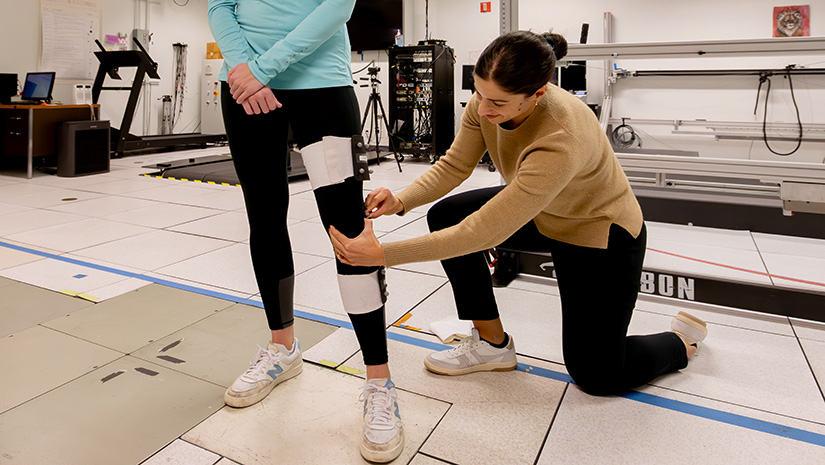 Our research on musculoskeletal injury mechanics spans several clinical domains:
- How gait may impact joint loading and serve as a target for clinical intervention
- Understanding how changes in joint structure and function may lead to long-term pathology after knee injury (e.g., the development of post-traumatic osteoarthritis after ACL rupture)
- The investigation of parathyroid hormone and mechanical stimulation to increase bone mineral density after spinal cord injury
- Using real-time biofeedback to modify gait patterns and slow progression of knee osteoarthritis
4) Development of Robotic Tools to Understand and Rehabilitate Walking
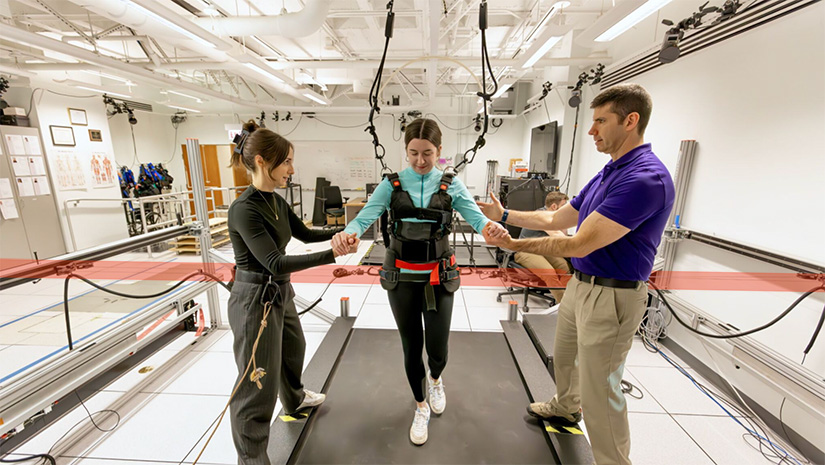
To study gait stability, maneuverability and adaptability, our team needed a unique tool to apply prescribed forces to the body while walking. To address this research need, we developed the Agility Trainer, a custom-built, cable-driven robotic device that applies highly controlled lateral forces to people during walking.
The Agility Trainer is anchored around an oversized treadmill that allows participants space to safely perform lateral and fore-aft maneuvers. Now developed, this very powerful, one-of-a-kind innovation is used by our team to conduct research that is leading our understanding of how humans learn locomotor agility.