Targeting genetic drivers of immune response in brain cancer.
The Dmello Lab
The Dmello Laboratory at Northwestern University Feinberg School of Medicine identifies and therapeutically exploits genetic determinants of immune vulnerability in brain tumors. Despite the transformative impact of immunotherapy in several cancers, its benefit in glioblastoma (GBM) — the most aggressive primary brain tumor — has been minimal.
We employ genome-wide CRISPR screening, integrated with cellular, molecular and immunological approaches, to systematically investigate regulators of anti-tumor immunity. A major focus of our lab (led by PI Crismita Dmello, PhD) is on the Checkpoint Kinase 2 (CHEK2) pathway, a key mediator of DNA damage response with emerging relevance in tumor immunobiology.
Recent Events
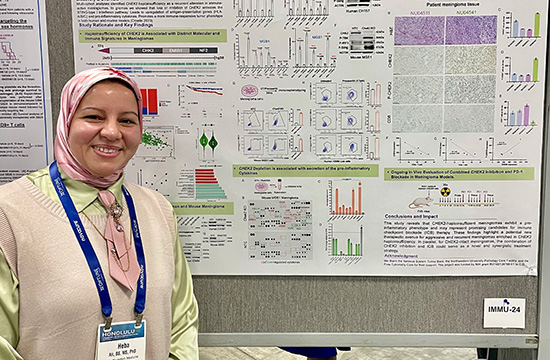
Society for Neuro-Oncology (SNO) Annual Meeting (2025) — Honolulu, HI
In November 2025, Heba Ali, PhD, presented our meningioma research through both an oral talk and a poster session. The research revealed how CHEK2 haploinsufficiency drives immune activation in aggressive meningiomas, enhancing antigen presentation and inflammatory signaling. These findings position CHEK2-deficient meningiomas as a promising subgroup for immune checkpoint blockade therapy.
Manuscript Accepted in Neuro-Oncology
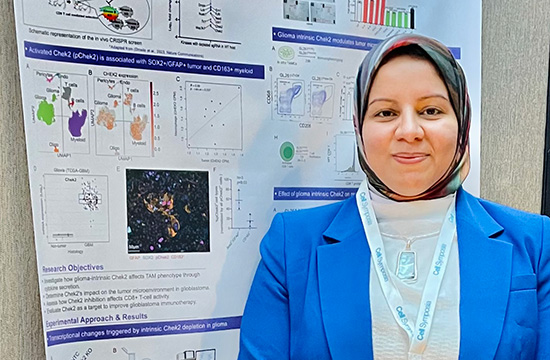
Cell Symposia: Drugging the Undruggable (2024) — San Francisco, CA
In December 2024, Heba Ali, PhD, presented our work titled “Glioma-Intrinsic CHEK2 Reprograms Tumor-Associated Macrophages.” The research showed that CHEK2 signaling in gliomas reshapes the myeloid compartment to promote immune suppression, underscoring CHEK2 as a promising target to enhance antitumor immunity.